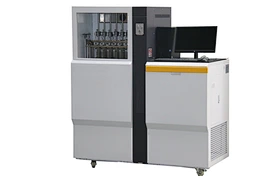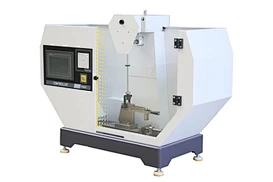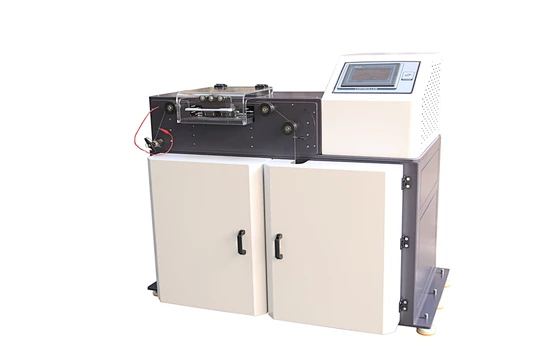
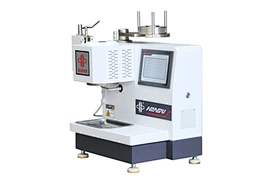
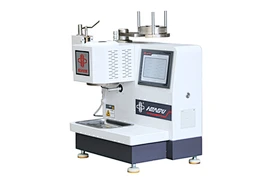
Melt Flow Rate Tester (Methods A and B)
HY-833AB
Melt Flow Rate Tester (Methods A and B) is primarily used to measure the melt flow rate (MFR) of various polymers in a viscous flow state. It is suitable for testing both high-melting-point engineering plastics (e.g., polycarbonate, polyarylsulfone, fluoroplastics) and low-melting-point materials (e.g., polyethylene, polystyrene, polypropylene, ABS resin, polyoxymethylene resin).
Widely applied in plastics production, plastic products, petrochemical industries, as well as universities, research institutes, and commodity inspection departments, it evaluates two key indicators: MFR (mass of thermoplastic melt passing through a standard die per 10 minutes) and MVR (volume of thermoplastic melt passing through a standard die per 10 minutes) under specific temperature and load. These values characterize the viscous flow characteristics of thermoplastics in a molten state.
Widely applied in plastics production, plastic products, petrochemical industries, as well as universities, research institutes, and commodity inspection departments, it evaluates two key indicators: MFR (mass of thermoplastic melt passing through a standard die per 10 minutes) and MVR (volume of thermoplastic melt passing through a standard die per 10 minutes) under specific temperature and load. These values characterize the viscous flow characteristics of thermoplastics in a molten state.
Quantity:
HY-833AB Melt Flow Rate Tester (Methods A and B)
In accordance with standards:
ASTM D 1238 D3364, ISO 1133, GB/T 3682
Product Description:
This tester is primarily used to measure the melt flow rate (MFR) of various polymers in a viscous flow state. It is suitable for testing engineering plastics with higher melting temperatures, such as polycarbonate, polyarylsulfone, and fluoroplastics, as well as materials with lower melting temperatures, such as polyethylene, polystyrene, polypropylene, ABS resin, and polyoxymethylene resin. It is widely used in the plastics production, plastics products, and petrochemical industries, as well as in relevant universities, research institutes, and commodity inspection departments. The melt flow rate (MFR) refers to the mass of a thermoplastic melt passing through a standard die per 10 minutes, expressed as MFR, and the volume of a thermoplastic melt passing through a standard die per 10 minutes, expressed as MVR, under a specific temperature and load. These values characterize the viscous flow characteristics of a thermoplastic in a molten state.
Technical Parameters:
1. Temperature Control: Room Temperature +10°C to 300°C, using dual PID temperature control, Delta temperature module, accuracy of ±0.1°C, and over-temperature protection.
2. Control method: PLC + HMI LCD touch screen
3. Cylinder diameter: 9.55 ± 0.0076 mm
4. Cylinder depth: 162 mm
5. Piston diameter: 9.4742 ± 0.0076 mm
6. Piston foot length: 6.36 ± 0.1 mm
7. Pore die dimensions: Pore diameter 2.0955 ± 0.0051 mm (Φ), length 8 ± 0.02 mm (L)
8. Measurement method: Mass and volume methods
9. Weight application method: Prefabricated weights, automatic pressure application
10. Equipped with a displacement measurement system, it automatically measures the sample's travel distance in the barrel, enabling volumetric measurement, eliminating sample cutting, simplifying the operation process, and improving test accuracy and efficiency.
11. Displacement accuracy: 0.001 mm
12. Sampling settings: Automatic and manual cutting options available, with a setting time of 0.1 to 999.9 minutes, and the cutting interval can be arbitrarily set within this range.
11. Displacement accuracy: 0.001 mm
12. Sampling settings: Automatic and manual cutting options available, with a setting time of 0.1 to 999.9 minutes, and the cutting interval can be arbitrarily set within this range.
13. Cutting method: Rotary cutter with adjustable rotation speed.
14. Sample outlet control mode: The equipment is equipped with a sample outlet control handle, which allows selection of mold removal, material blocking, and sample discharge.
15. The software has a calculation function. After weighing the sample, the software can calculate density, mass flow rate, volume flow rate, and flow rate ratio, eliminating manual calculations. It also has a statistical function, which can average multiple test data sets and display the average value.