
Will Your Bag Survive the Journey? 5 Key Testing Standards Every Luggage & Handbag Manufacturer Should Know
2026-06-24
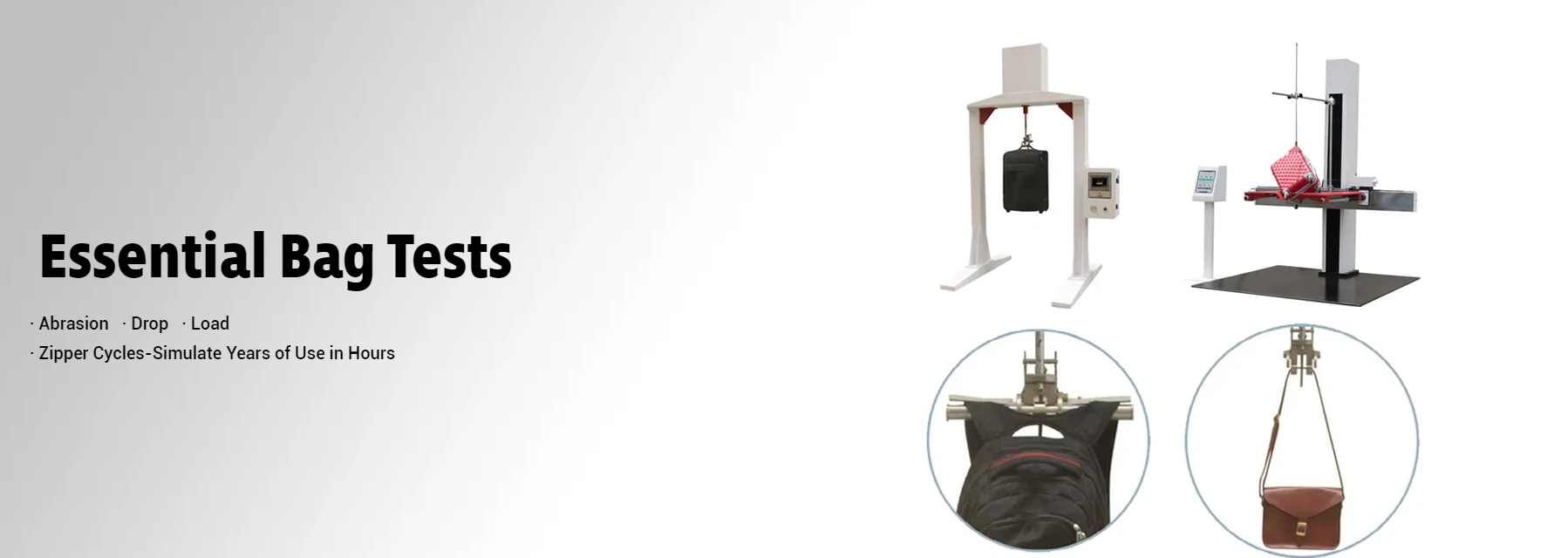
A suitcase that fails at baggage claim, a zipper that splits under load, a handle that tears away from the body of a bag — these are not just inconveniences. For manufacturers, they mean returns, reputational damage, and lost repeat orders. Luggage, bags and handbags are designed to ensure the safe transit of valuable personal items, making it necessary to test for the strength of fastenings, buckles, handles and wheels. The challenge is that "durability tested" as a phrase has become almost meaningless without specifics. Real luggage durability testing is about forcing a loaded case through repeatable abuse, then checking whether the wheel system, telescopic handle, shell, zippers and attachment points still work within a defined tolerance. Here are the five testing dimensions that matter most. ISO Wikipedia
1. Drop and Impact Testing — Simulating Real-World Handling
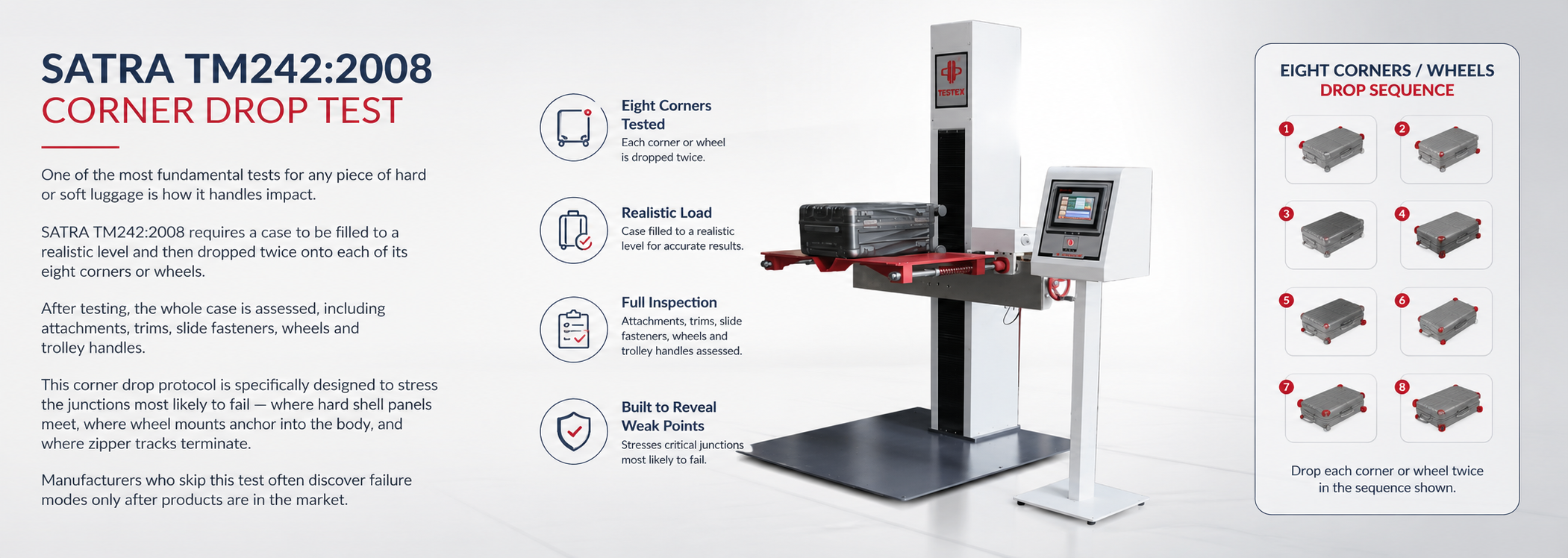
One of the most fundamental tests for any piece of hard or soft luggage is how it handles impact. SATRA TM242:2008 requires a case to be filled to a realistic level and then dropped twice onto each of its eight corners or wheels. After testing, the whole case is assessed, including attachments, trims, slide fasteners, wheels and trolley handles. This corner drop protocol is specifically designed to stress the junctions most likely to fail — where hard shell panels meet, where wheel mounts anchor into the body, and where zipper tracks terminate. Manufacturers who skip this test often discover failure modes only after products are in the market.
2. Zipper Fatigue Testing — The Most Common Point of Failure
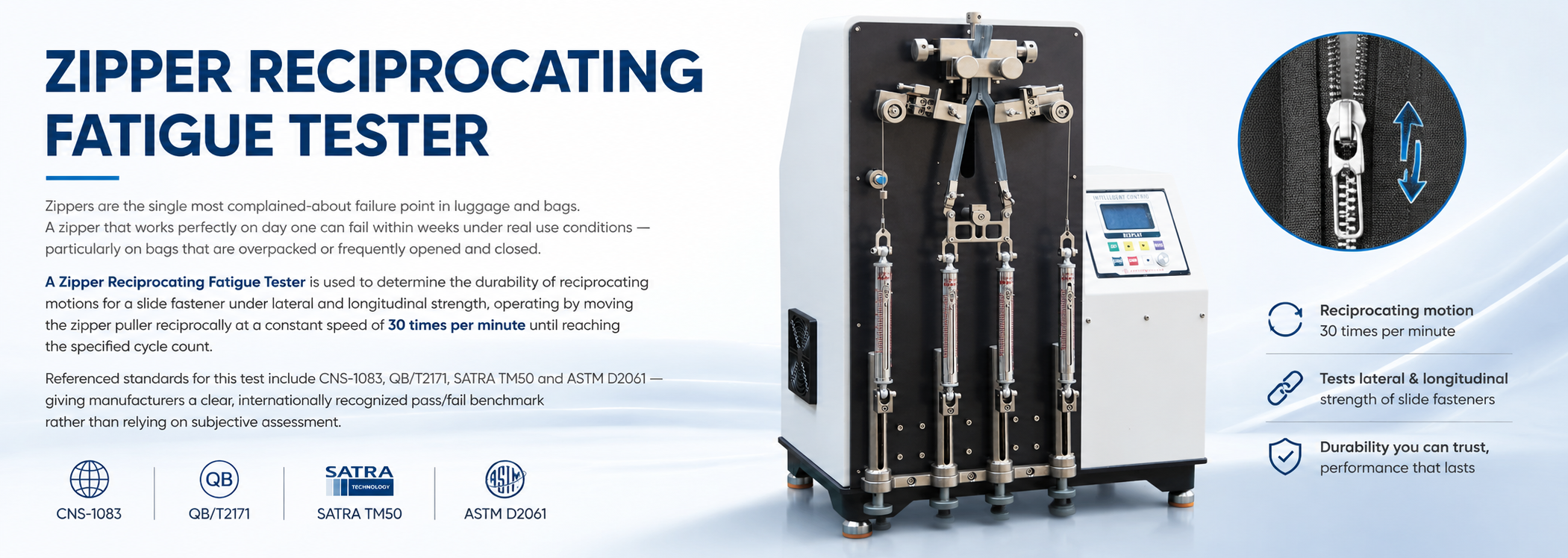
Zippers are the single most complained-about failure point in luggage and bags. A zipper that works perfectly on day one can fail within weeks under real use conditions — particularly on bags that are overpacked or frequently opened and closed. A Zipper Reciprocating Fatigue Tester is used to determine the durability of reciprocating motions for a slide fastener under lateral and longitudinal strength, operating by moving the zipper puller reciprocally at a constant speed of 30 times per minute until reaching the specified cycle count. Referenced standards for this test include CNS-1083, QB/T2171, SATRA TM50 and ASTM D2061 — giving manufacturers a clear, internationally recognized pass/fail benchmark rather than relying on subjective assessment.
3. Wheel Abrasion Testing — Proving Wheels That Actually Last
4. Handle Strength and Snatch Testing — Where Bags Most Often Fail Structurally
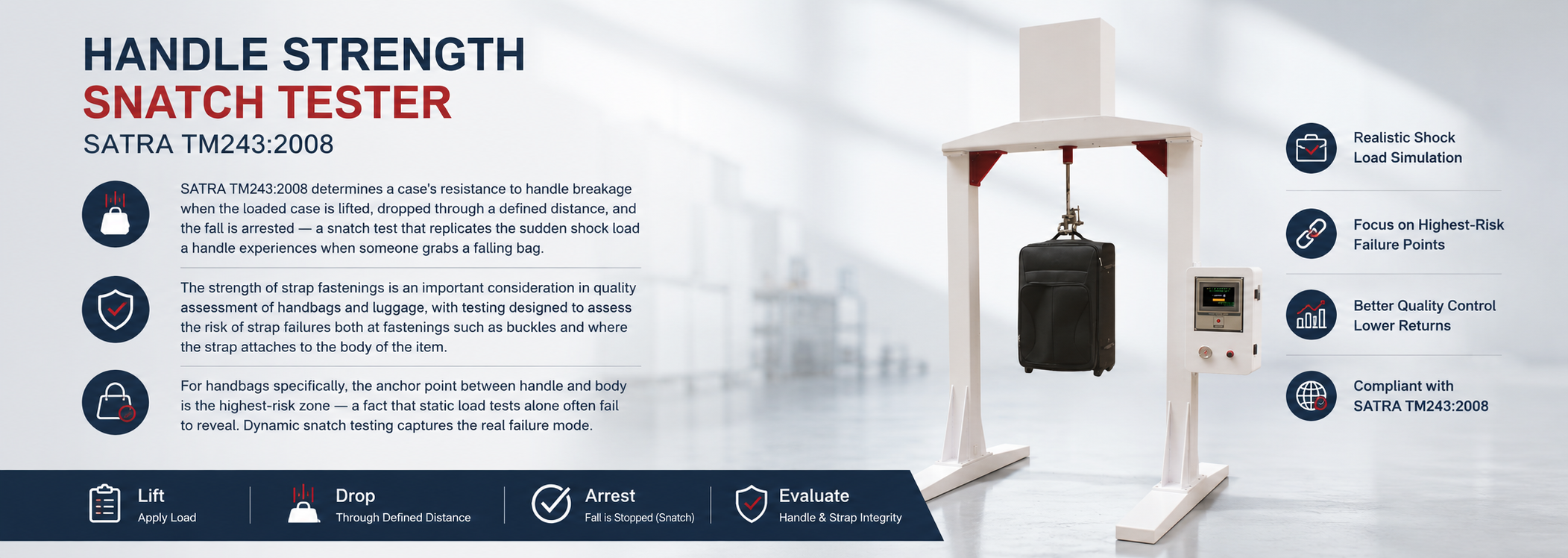
SATRA TM243:2008 determines a case's resistance to handle breakage when the loaded case is lifted, dropped through a defined distance, and the fall is arrested — a snatch test that replicates the sudden shock load a handle experiences when someone grabs a falling bag. The strength of strap fastenings is an important consideration in quality assessment of handbags and luggage, with testing designed to assess the risk of strap failures both at fastenings such as buckles and where the strap attaches to the body of the item. For handbags specifically, the anchor point between handle and body is the highest-risk zone — a fact that static load tests alone often fail to reveal. Dynamic snatch testing captures the real failure mode. Cerz8 ISO
5. Compression and Structural Integrity Testing — Protecting What's Inside
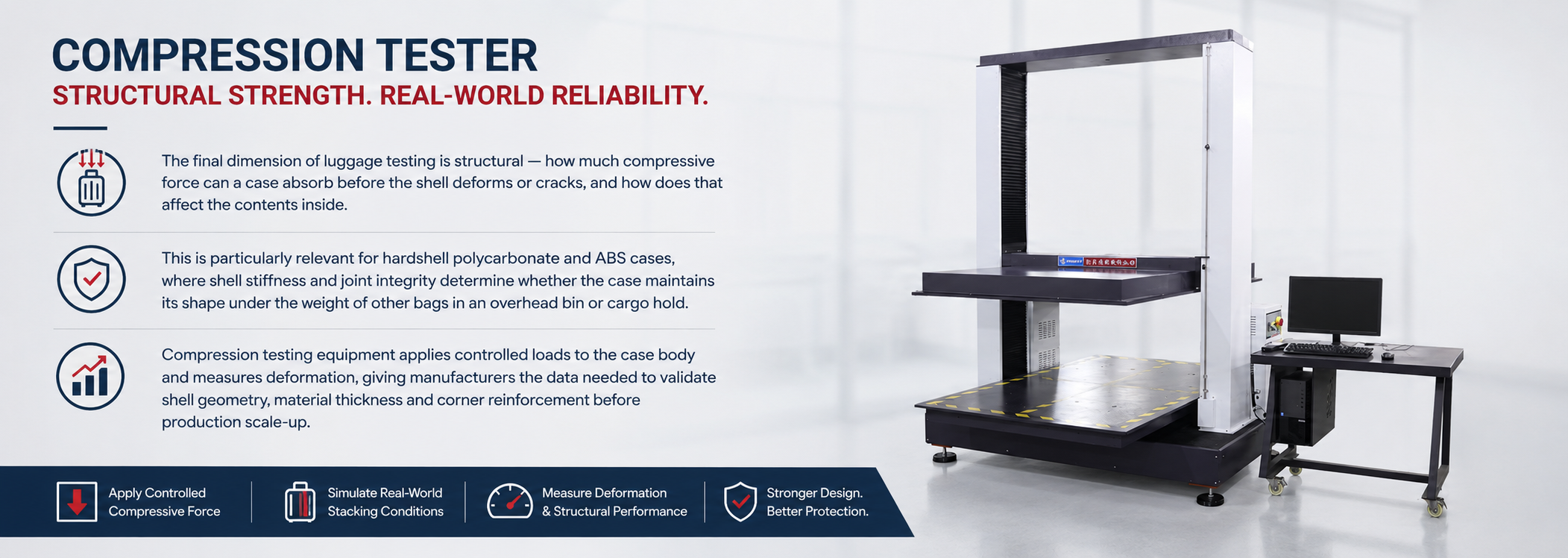
The final dimension of luggage testing is structural — how much compressive force can a case absorb before the shell deforms or cracks, and how does that affect the contents inside. This is particularly relevant for hardshell polycarbonate and ABS cases, where shell stiffness and joint integrity determine whether the case maintains its shape under the weight of other bags in an overhead bin or cargo hold. Compression testing equipment applies controlled loads to the case body and measures deformation, giving manufacturers the data needed to validate shell geometry, material thickness and corner reinforcement before production scale-up.
Why a Systematic Testing Protocol Matters
A credible pass result after luggage handle and wheel testing should show that the case still rolls, the wheels still align, the trolley still extends and locks cleanly, the handle play stays within agreed tolerance, the shell around the wheel mounts has not cracked, and the grip or anchor zone has not loosened enough to change user feel. No single test achieves all of this. It takes a coordinated testing protocol — covering drop impact, zipper fatigue, wheel abrasion, handle snatch and compression — to build a complete picture of product durability before it reaches the consumer. Wikipedia
For manufacturers supplying major retail chains, airline amenity kit programs or branded luggage labels, having documented test data across all five of these dimensions is increasingly a baseline expectation at audit — not a differentiator, but a minimum requirement.
Conclusion
The luggage and handbag market rewards products that travel well — not just in the marketing sense, but literally. Wheels that don't wobble after 500 km. Zippers that still close cleanly after 10,000 cycles. Handles that don't pull away from the body on the first heavy trip. Getting there requires a testing approach that mirrors real-world abuse, not just lab conditions, and an equipment setup capable of generating the kind of quantified, standard-referenced data that today's buyers and auditors expect to see.